Delhi: Policy-making, national security and parliamentary debate form the backbone of any democracy. Parliament is not merely a platform for confrontation between the ruling party and the opposition, but the highest forum for national unity, collective wisdom and responsible expression. Therefore, when discussions take place on a constitutional and dignified occasion such as the President’s Address, it is naturally expected that leaders exercise extra caution in their choice of words, references and timing.
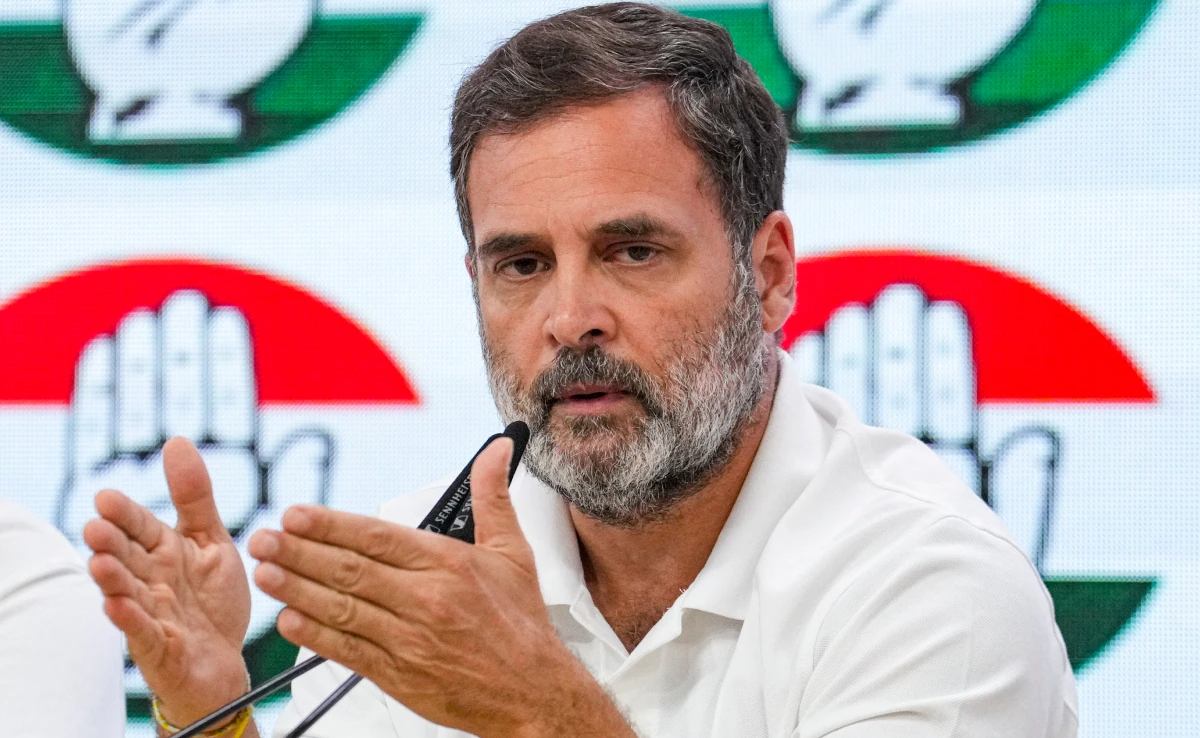
In this context, the recent statement by Leader of the Opposition in the Lok Sabha, Rahul Gandhi, during the debate on the President’s Address, has raised serious questions. By citing selected excerpts from an unpublished book of former Army Chief General M.M. Naravane regarding alleged Chinese incursions, Rahul Gandhi triggered a major controversy. The government accused him of misleading the House, while the opposition countered that the government was attempting to suppress the truth. The outcome was disruption of parliamentary proceedings, sharp exchanges between both sides and the adjournment of the House, shifting the national discourse from substantive issues to political blame games.
The issue goes beyond a single statement and touches upon political maturity, responsibility and understanding of national interest. Matters related to national security demand utmost sensitivity in public discourse. Facts related to borders, military deployment and strategic assessments are highly sensitive, and selective or incomplete references can create unnecessary confusion. This is why Defence Minister Rajnath Singh and Home Minister Amit Shah termed the remarks a violation of parliamentary rules and a threat to national security. When a leader insists on sticking to such statements despite repeated rulings from the Speaker, it raises doubts about whether the intention was to reveal facts or to gain political mileage.
While questioning the government is the duty of the opposition and the essence of democracy, the language, platform and timing of such questions must adhere to democratic norms. The debate on the President’s Address is meant for comprehensive discussion on government policies, achievements and future direction. Turning it into a political weapon by quoting selective portions of military memoirs, without proper context or institutional process, was bound to generate controversy. The opposition’s claim that the government is uncomfortable with tough questions is a familiar political argument, but the government’s assertion that national security should not be politicised carries equal weight. A balance is possible only when facts, procedures and timing are respected.
Controversy over citing an unpublished memoir in Parliament is not surprising. Parliamentary traditions and established rules do not permit members to quote unpublished books, articles or documents as evidence unless they are formally tabled and verified by the House. Presenting excerpts from an unpublished book as final truth on matters of national importance not only violates parliamentary norms but also undermines the dignity and credibility of parliamentary proceedings.
Rahul Gandhi is not just a Congress leader but the Leader of the Opposition. At the very least, on issues of national security, he is expected to stand with the narrative of India’s armed forces. Instead, his repeated attempts to corner the Modi government on China and Pakistan ignore the fact that territorial intrusions by both countries occurred when the Congress was in power. His reference to alleged excerpts from an unpublished book on the Galwan clash was bound to provoke uproar. How can an unpublished book be cited in Parliament? His allegation that the Modi government failed to show courage against China is baseless and misleading. This is not the first time Rahul Gandhi has attempted to portray the government as weak on China, even claiming in the past that China has occupied Indian territory and that Indian soldiers were beaten—remarks for which he was reprimanded by the Supreme Court.
The reality, well known to the country, is that the Indian Army gave a strong response in Galwan, compelling China to engage in dialogue and restore the status quo in several areas of Ladakh. Despite this, Rahul Gandhi continues to indulge in superficial allegations on national security, showing little willingness to learn from past criticism.

The Congress party too needs serious introspection. Once a party that led the nation, it now frequently finds itself trapped in controversies where rhetoric overshadows substance. Rahul Gandhi is an influential speaker with the ability to connect with youth, but that also brings greater responsibility. Repeatedly raising issues that the ruling side portrays as harmful to national unity strengthens the perception of the Congress as an irresponsible opposition—whether entirely fair or not. In politics, perception often matters as much as fact.
In mature democracies, debates on national security are handled through parliamentary committees, closed-door sessions and institutional mechanisms. Public statements by leaders are usually limited to policy questions rather than detailed military references. India too needs to evolve such a tradition, where the opposition demands accountability without turning the credibility of the armed forces into an arena for political contest.
At the same time, the government should not fear transparency. If the opposition cites a book or report, a factual and institutional response is preferable to merely invoking rule violations. Complete silence in the name of national security also runs contrary to democratic accountability. Both sides must recognise their limits.
Ultimately, the question is one of Rahul Gandhi’s political maturity. Maturity does not mean silence, but understanding when, where and how to raise an issue. A national leader is expected to act with strategic wisdom rather than emotional impulse. Likewise, it is the collective responsibility of the opposition to make Parliament a forum for meaningful debate, not repeated disruptions. An adjourned House is not a victory for anyone—it is a loss for democracy.
This episode once again highlights the power of words in a diverse and sensitive democracy like India. National unity is safeguarded not only by defending borders, but also by responsible politics. The Congress must reflect on whether short-term political gains are worth long-term credibility. Rahul Gandhi must introspect on the fact that leadership is built not only by questioning, but also by restraint and timing. And the government must remember that a strong nation is strengthened not by avoiding questions, but by answering them. Only then can Parliament truly serve the national interest.